Updated October 2026 | By Josh Stanley, Owner, Palmetto Choice Insurance Agency | Licensed in South Carolina and North Carolina
If your renewal notice came with a bigger premium, a new percentage deductible, or a surprise note about your roof, you are not imagining things. South Carolina homeowners insurance rates have climbed by roughly 20% on average, and the changes go well beyond price. The way carriers cover roofs and storm damage is shifting too.
You have more options than the renewal notice suggests. Below, I explain one major reason why the market is moving and what to do about it. To skip ahead, get a homeowners quote or call us at (864) 707-1234.
How Insurance Companies Decide Where to Write Policies
Law of large numbers in plain English
Insurers rely on a simple statistical idea called the law of large numbers. Smaller sample sizes can mislead data analysts. The larger the sample size, the closer the average comes to the true average.
Underwriters work to keep their data representative. If active policies are highly concentrated in a small portion of the state, the sample sizes do not reflect true statewide figures. Ideally, they will want an even distribution of policies that reflect the significance of each county to the state as a whole. If half of an insurance company’s business is in one or two counties, the data will be skewed and will not represent the state as a whole.
Coastal vs. Inland: How Helene Turned the Old Risk Map Upside Down
How Carriers Have Split South Carolina
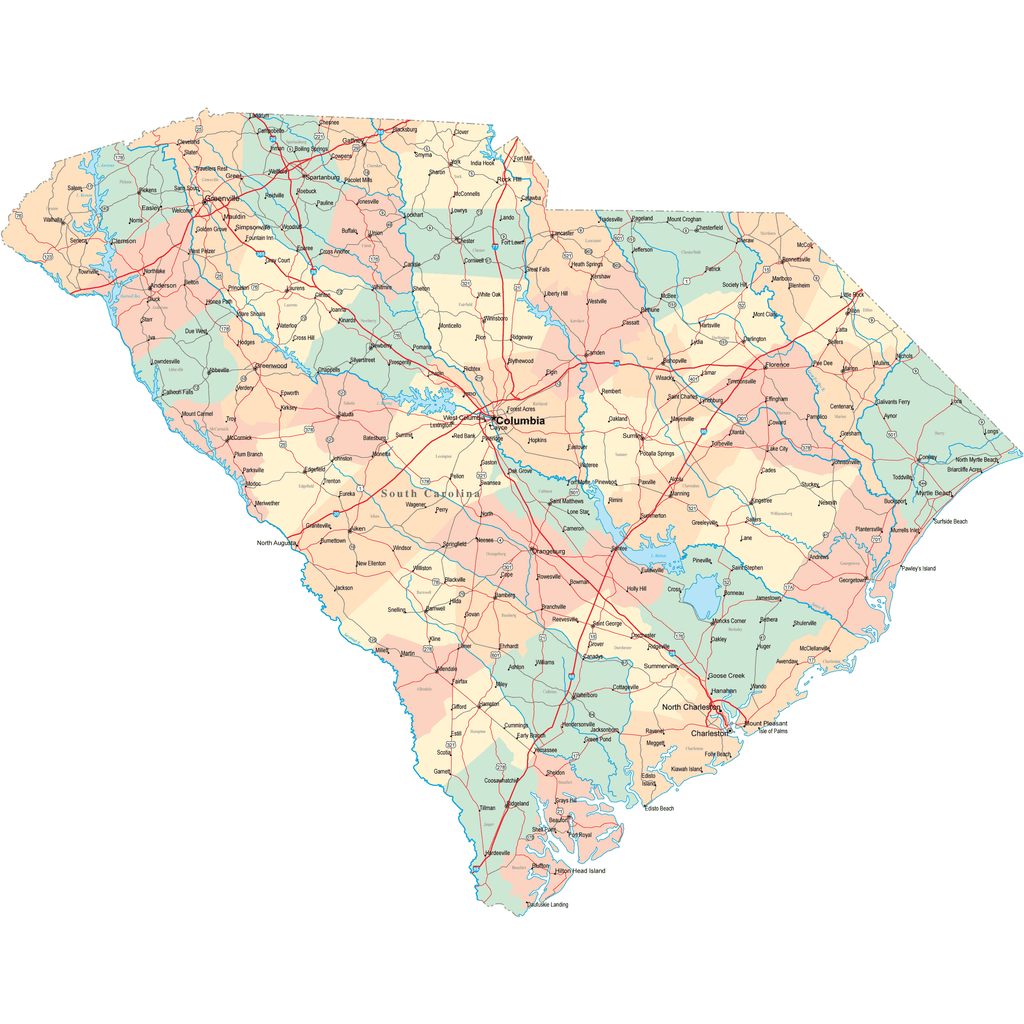
For years, underwriters have effectively treated South Carolina as having two distinct regions: coastal and inland. Guidelines are set largely by county – while it’s not 100% accurate, it’s simple to picture I-95 as an informal dividing line. Coastal counties were grouped together as the high-risk windstorm territory, and inland counties, including most of the Upstate, were treated as lower risk.
What Hurricane Helene did to the Data
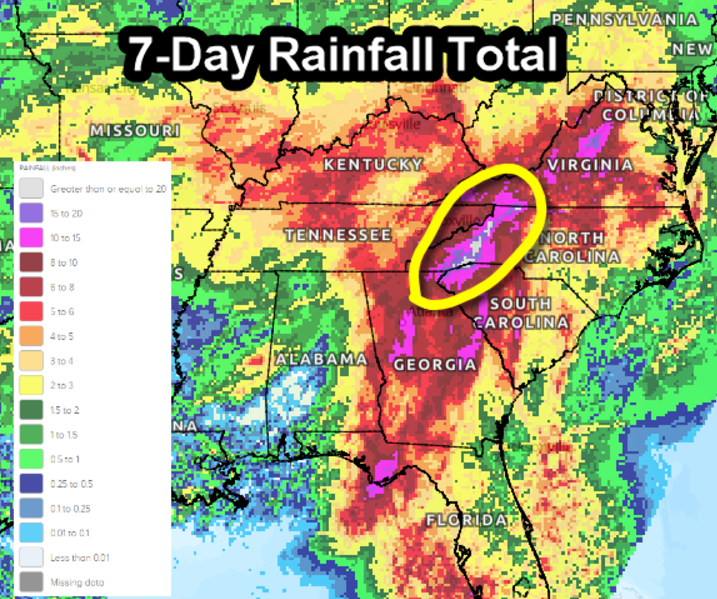
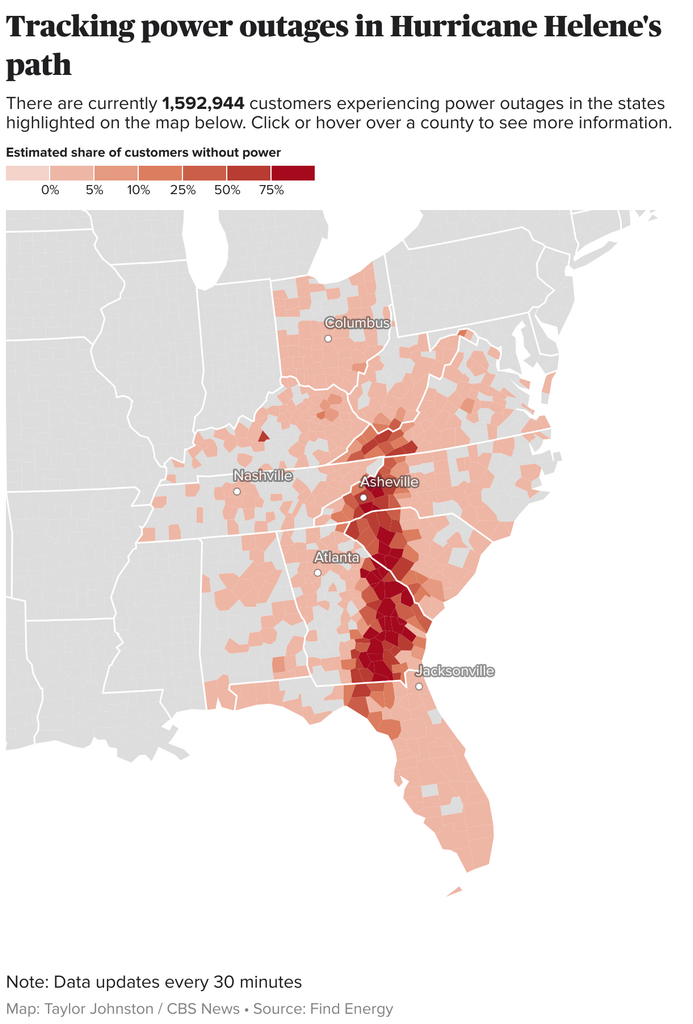
Helene did not follow that map. It largely passed over the coastal areas carriers consider highest risk and did its worst damage inland, across the Appalachian mountains and foothills, the Upstate, and the corridor running down the Georgia and South Carolina line.
The maps tell the story:
- Rainfall: a seven-day rainfall map shows the heaviest totals, 10 to 20 inches, concentrated over the mountains where North Carolina, South Carolina and Georgia meet, not along the coast. The higher rainfall totals were a driving factor in the storm damage. When coupled with local topography, the impact was compounded.
- Power outages: an outage map from www.cbsnews.com shows the hardest-hit areas, where 50% to 75% or more of customers lost power, forming a corridor from Asheville down through the Upstate and into Georgia. The impact was less severe along the coast.
Carriers had built their numbers on the idea that coastal means higher hurricane risk and inland means lower risk. Helene gave them an inverted data set: lots of storm losses in places priced for lower risk. That is why inland homeowners are now seeing coastal-style rate increases, higher named storm deductibles, and new roof rules.
If you live in Spartanburg, Greenville or western North Carolina, “we are inland, so hurricanes are a lesser concern” no longer matches how many carriers view your risk exposure.
What can Carriers do After a Catastrophe?
- What carriers generally cannot do: penalize individual policyholders for filing a claim on a loss that is classified as catastrophic.
- What carriers can do: stop accepting new applications in certain counties or even entire states. They may even cease offering renewals altogether. That limits future exposure, but it does not address a balance sheet currently in the red.
So carriers turn to two other levers: raising rates, which is why South Carolina premiums are up around 20% on average, and reducing what they are likely to pay out. The second catches most homeowners off guard, and it starts with the roof.
Not sure what your renewal means? Get a homeowners quote and we will compare it across our carriers.
Roof Coverage Is Changing: Replacement Cost vs. Actual Cash Value
The roof is the part of a house most exposed to windstorm damage, so it is a common place to see coverage limitations.
Then: full replacement cost on roofs of any age
Many homeowners quietly treated their policy as a roof maintenance plan: a storm rolls through, a roofer finds damage, and the claim buys a new roof. For years, most carriers offered full replacement cost on roofs of any age.
Now: full replacement cost to 10-15 years, then depreciation
That is changing. Most carriers now pay roof claims at full replacement cost only up to roughly 10 to 15 years of age. After that, they apply a depreciation schedule, often called actual cash value (ACV) roof coverage. By that point, expect the payout to fall to somewhere in the range of 25% to 60% of the full replacement value. Be careful to read your policy and endorsements before purchasing – there are some homeowner policies that pay roofs at ACV at ANY age!
As an illustration, if a $20,000 roof is paid at 25% to 60% of value because of its age, the claim pays $5,000 to $12,000 (minus the deductible) and you cover the rest. Your numbers will differ, so reference your policy or talk to your agent.
Why a long-life roof may not earn extra credit
A metal or other long-life roof might seem to deserve better treatment, but carriers are generally not giving credit for longer-life materials when setting eligibility and depreciation. Until that changes, treat 20 to 25 years as a practical hard cap on a roof’s life for insurance purposes. As a side note, as of October 2026 we are only seeing the very beginning of longer-life roofs being treated differently, but that’s the exception, not the rule. Most carriers still have a hard cap around 20 to 25 years.
Do not treat insurance as a roof maintenance plan
Insurance is built for sudden damage, not aging. Budget for replacement as your roof nears the 10-to-15-year mark, and know before a storm how your policy will pay. No matter the age of your roof, ALWAYS talk to your agent before filing a claim.
Wind, Hail and Named Storm Deductibles Are Now Standard Inland
Coastal policies have long separated the deductible for wind or named storms from the deductible for everything else, called all other perils (AOP). Some coastal property policies exclude wind and hail altogether. Because of the Helene losses, that split deductible is now pretty standard in inland areas of South Carolina as well. There are still some programs that will allow the same deductible across the board, but it’s much less common.
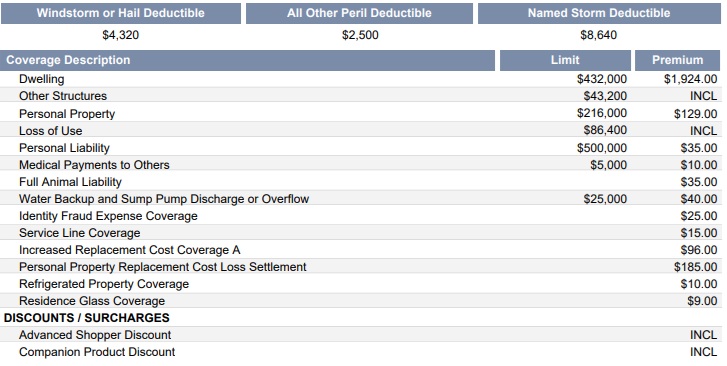
This sample declarations page is for one house with a $432,000 dwelling limit. It carries three different deductibles, and which one applies depends on what caused the damage. Below is a summary, then an actual policy sample. This is only an example, and it’s important to note that a % deductible changes as the coverage amount changes. So it may have a very different impact on your home than in this example. It’s also worth noting that your coverage amount frequently changes year to year to keep up with changes in material costs, so a % deductible means the actual deductible amount will change somewhat over time.
| Cause of loss | Deductible you pay | Share of dwelling limit |
| All other perils (fire, theft, water, etc.) | $2,500 | Flat dollar amount |
| Wind/hail | $4,320 | 1% |
| Named storm | $8,640 | 2% |
What a percentage deductible gets you after a storm
The point: the same house can have very different out-of-pocket costs depending on the cause of loss. A kitchen fire costs you $2,500 before the policy pays. A hailstorm costs you $4,320. A named storm (hurricane) costs you $8,640, more than three times as much, on the very same policy. Check yours this week.
That gap between the everyday deductible and the storm deductible is exactly what the newer buyback products are designed to cover, which is the next section.
If you own rental property, this applies to landlord policies too.
Want someone to look at your deductibles? Want to lower your South Carolina homeowners insurance rates? Get a homeowners quote or call (864) 707-1234.
Deductible Buyback Policies: A New Way to Cover the Gap
What they are
As carriers moved to higher wind and storm deductibles, the market responded. Third-party deductible buyback products now exist that pay the difference between a minimum deductible you choose and the higher wind or storm deductible on your homeowners policy. Instead of facing $8,640 after a named storm, you might owe a much smaller amount, depending on the terms.
Availability, eligibility and pricing vary, so we will confirm what is offered in your state and with your carrier before recommending anything.
Who should consider one
A buyback may be worth a look if:
- Your wind/hail or named storm deductible is a percentage of your dwelling limit.
- A deductible of several thousand dollars would be a hardship after a storm.
It is an added cost, so we will walk through the numbers together.
How an Independent Agent helps you adjust
Palmetto Choice is an independent agency representing a variety of insurance carriers. We work for you, not an insurance company, and will sort through the carrier guidelines and rate structures to identify the best match for you.
When a client sends us a renewal, we review:
- Roof age and settlement terms: replacement cost or actual cash value, and where the depreciation schedule starts, if applicable.
- Deductible structure: AOP, wind/hail and named storm, in dollars and as a percentage.
- Dwelling coverage: whether the limit still reflects what it would cost to rebuild today.
- Buyback options: whether a deductible buyback makes sense and is available for your address.
- Price across carriers: how your renewal compares once the terms are comparable.
If you have a home and a car, we can look at whether to bundle home and auto too. South Carolina homeowners insurance rates fluctuate over time, so we try to keep your insurance in the best shape over time.
Homeowners Insurance Frequently Asked Questions
Why are my South Carolina homeowners insurance rates going up?
One major factor is when Hurricane Helene hit inland areas that carriers had priced as low risk, which left them with higher claim costs and depleted reserves. They are responding with higher rates and tighter terms on roofs and deductibles. This is just one condition to consider, there are still many other factors that will impact premiums.
Can my insurance company drop me after Helene?
Carriers generally cannot penalize you for a claim on a loss classified as catastrophic. They can, however, stop accepting new applications in certain counties or states, or even discontinue offering renewals. Renewal guidelines differ by policy, carrier and state. If you get a non-renewal or change notice, call us right away.
What is a named storm deductible?
A named storm deductible is a separate deductible, often a percentage of your dwelling coverage, that applies to damage from a named storm (typically a hurricane). It is usually higher than your AOP deductible. On a $432,000 dwelling in the example above, a 2% named storm deductible is $8,640.
Is my roof covered at replacement cost or actual cash value?
It depends on your policy and your roof’s age. Many carriers now pay full replacement cost only up to about 10 to 15 years, then apply a depreciation schedule. Some property policies pay ACV on the roof from regardless of age. Check your policy contract for roof language, or send it to us.
Do you write homeowners insurance in North Carolina?
Yes. We are licensed in both North Carolina and South Carolina, and we help homeowners in western North Carolina and across the Upstate.
Get a homeowners insurance review before your next renewal
Find out where your renewal stands. Send us your current declarations page and we will compare your roof terms, deductibles and rate across 100+ carriers. It is free and there is no obligation. Keep higher South Carolina homeowners insurance rates at bay.
- Get my homeowners review
- Call or text us at (864) 707-1234
- Palmetto Choice Insurance Agency, 970 Howard St, Spartanburg, SC 29303 | palmettochoice.com
Insurance coverage varies by carrier, policy and location. This article is general information, not a coverage recommendation or guarantee of savings. Review your own policy for the terms that apply to you.